The EB‑3 “Other Worker/ Unskilled ” visa offers a clear, employment‑based path to U.S. permanent residence for candidates who may not have advanced degrees or specialized skills. However, the journey from initial sponsorship to green card approval involves multiple government agencies, strict documentation requirements, and waiting periods that can span several years.
This page explains the EB‑3 processing timeline step by step: from prevailing wage determination and PERM labor certification, through the I‑140 immigrant petition and visa bulletin wait, to the final consular interview or adjustment of status. By understanding each stage, its typical duration, and the factors that can cause delays, applicants and employers can set realistic expectations and plan more effectively for a successful EB‑3 case.
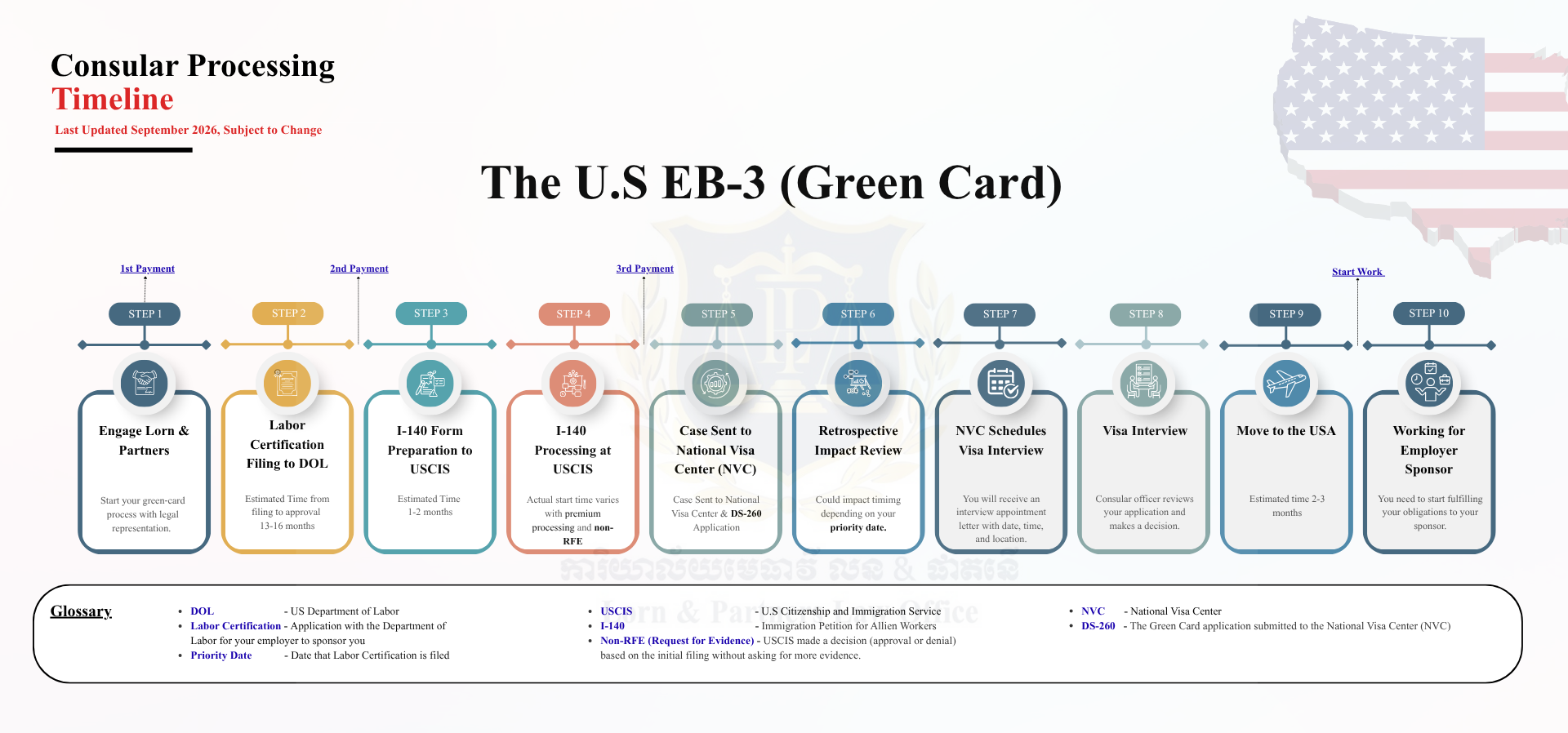
EB-3 Consular Processing Timeline Explained
Step 1: Engage Lorn & Partners Law Office
Begin your green-card process by consulting with an experienced immigration law office. The legal team will evaluate your employment opportunity, sponsoring employer, job requirements, qualifications, family situation, and potential immigration concerns.
Step 2: Labor Certification Filing with the Department of Labor (DOL)
The sponsoring employer begins the labor-certification process by obtaining the required prevailing wage and completing the necessary recruitment procedures. Recruitment is designed to determine whether qualified U.S. workers are available for the position and must be properly documented. The labor-certification process may take approximately 13–16 months, depending on government processing times and whether the case is audited.
Step 3: Prepare Form I-140
After the labor-certification requirements are completed, the employer and immigration legal team prepare Form I-140, Immigrant Petition for Alien Workers. The petition identifies the employer, position, work location, offered wage, job requirements, recruitment history, and foreign worker. The employer must also demonstrate its ability to pay the offered wage and show that the worker meets the position’s requirements.
Step 4: Form I-140 Processing by USCIS
The employer files Form I-140 with U.S. Citizenship and Immigration Services (USCIS). Processing time varies depending on the case and whether premium processing is available or selected. USCIS may approve the petition, deny it, or issue a Request for Evidence (RFE) asking for additional documentation.
Step 5: Case Sent to the National Visa Center (NVC)
After Form I-140 approval and when an immigrant visa number becomes available, the case is transferred to the National Visa Center (NVC).
The applicant and family members complete the required immigrant-visa documentation, submit supporting civil and financial documents, pay the required fees, and complete the DS-260 Immigrant Visa Application.
Step 6: Retrospective Impact Review
The visa process may be affected by changes in visa availability and the applicant’s priority date. The priority date is generally connected to the date the labor-certification application was filed. The applicant should monitor the Visa Bulletin and consider how changes in visa availability may affect the timing of the case.
Step 7: NVC Schedules the Visa Interview
After the National Visa Center determines that the case is documentarily complete and an immigrant visa is available, it schedules the visa interview. The applicant receives an appointment letter containing the interview date, time, and location. The applicant must follow the instructions regarding required documents and the medical examination.
Step 8: Attend the Visa Interview
The applicant attends the immigrant-visa interview at the U.S. Embassy in Phnom Penh. A consular officer reviews the application, supporting documents, medical-examination results, and eligibility for an immigrant visa. The officer may approve the application, request additional documents, place the case under administrative processing, or refuse the visa if the legal requirements are not satisfied.
Step 9: Move to the United States
After the immigrant visa is issued, the applicant may travel to the United States and request admission as a permanent resident. The estimated preparation and relocation period may be approximately 2–3 months, depending on visa issuance, travel arrangements, and other circumstances.
Step 10: Begin Working for the Sponsoring Employer
After entering the United States as a lawful permanent resident, the worker should begin fulfilling the employment obligations associated with the sponsoring employer and approved position. The worker and employer should maintain accurate records and comply with all applicable immigration and employment requirements.

1st-Select Specific Job Sponsor
You first need a U.S. employer willing to sponsor you and a specific permanent job offer that fits one of the EB‑3 categories (skilled, professional, or other worker).
2nd-Department of Labour (DoL)
PERM Labour Certification is the first and most legal-department heavy part.
3rd-U.S Citizenship and Immigration Services (USCIS)
After PERM approval, the lawyer files Immigrant Petition for Alien Worker Form with USCIS.

4th-Green Card Application
Once the priority date is current, you either file Form I‑485 (adjustment of status inside the U.S.) or go through consular processing with DS‑260 at a U.S. embassy in Cambodia.
EB-3 Processing Time
How Long Does the EB-3 Visa Process Take?
The EB-3 visa process is generally not a fast immigration pathway. From the initial stage of labor certification through to the final issuance of a green card, the overall timeline typically ranges from approximately three to five years, and in some cases may take longer.
Processing times may vary depending on several factors, including visa bulletin backlogs, the workload of U.S. Citizenship and Immigration Services (USCIS), and the applicant’s country of origin.
Engaging an experienced EB-3 immigration attorney may help reduce avoidable delays and ensure that the case is prepared and processed as efficiently as possible in accordance with applicable immigration laws and procedures.
Your American Dream Starts With One Conversation
Free initial eligibility check

The EB‑3 pathway involves several regulated stages and requires careful planning, accurate documentation, and realistic expectations. This guide explains the standard process and provides practical timeline guidance for Cambodian workers considering the EB‑3 “Other Worker/ Unskilled” category.
Understanding the EB‑3 Process and Timeline
While the EB‑3 process is lengthy and highly regulated, it is also predictable when approached with accurate information and careful preparation. Knowing the standard sequence—PERM, I‑140, visa bulletin wait, and final green card step—allows applicants to anticipate key milestones and avoid unnecessary setbacks caused by missing documents, inconsistent records, or unrealistic timelines.
EB‑3 Planning Guidance for Cambodian Workers
For Cambodian workers considering the EB‑3 “Other Worker/ Unskilled” category, this timeline should be used as a planning tool rather than a guarantee. Processing times change, so regular checks of official DOL and USCIS data, together with guidance from qualified immigration counsel, remain essential. With patience, compliance, and a clear understanding of the process, the EB‑3 pathway can provide a reliable route to long‑term U.S. residence and work authorization.